Pages

Friday, 20 September 2024

Summer in Bangkok

July 2023

An evening's balcony birding

Setting slowly beneath the cityscape, the sun left a bright pink sky in its wake. I rushed to the balcony, hurriedly taking my binoculars out of their bag and placing them around my neck. The lenses steamed up in the high humidity, but I succeeded in cleaning them before the first sizeable flocks arrived. Before long, some twenty House Crows flew north over my apartment block. They floated gracefully from the Chao Praya River towards the gleaming forest of skyscrapers ahead, their jet black wings like oars rowing through the muggy air. With harsh, guttural cries echoing above the inner city, the corvids declared their return to their roosting site, located somewhere deep in the city centre.


Following the raucous murder of crows came the Asian Openbills. Small storks the size of Grey Herons, they navigated the seemingly infinite number of gaps and wind tunnels with ease between residential condominiums, futuristic towers, and swivelling cranes. Distant relatives, a handful of Little and Cattle Egrets, chose a more direct path and instead plummeted to their roosts deep below the steel emergents. A more elusive bird materialised on the horizon and then disappeared within moments. A Nigh Heron quickly carving through the twilight; it was disinterested in its urban cousins and headed east towards the sprawling suburbs.


Rhythmic purring diverted my attention to the lawn, twenty metres below the balcony. Peaceful Doves hopped around on the mowed grass, their numbers growing every few minutes as more flew in. They mixed and mingled with Tree Sparrows, so much smaller that only the chocolate-brown mosaics on their backs were visible to me. Some doves quickly tired of this gathering and flew to an aerial high up on a neighbouring roof, purring to a wide congregation of koels, mynas, and orioles seated around them. Very soon, the pleasant consistency the doves brought to the ears was challenged. Green Pigeons stole the show, crash-landing into the trees above the lawn and gurgling noisily. Their rather strange noises continued for the next half hour. However, what they lacked in their call repertoire was made up for in their glorious rainbow-coloured plumage. Hues of indigo surrounded a patch of brown on the tail, reaching upwards to the wingtips. Green covered the back and wings, a shade not dissimilar to that of the leaves around them. Fine yellow brushstrokes lined the wings, meeting deep orange at the chest and a gentle lilac extending to the head. I could only imagine these birds escaping from an artist's studio; enough to convince me they were not as bad as they sounded.


The balcony I stood on overlooked the inner-city district of Sathorn, so the sounds of traffic, at times, almost overpowered the evening conversations of the birds. The distant whooshing of cars on a motorway hung in the air as thousands of commuters headed home from work. Tuk-tuks charged behind the trees where the pigeons sat, the quick dugga-dugga-dugga-dugga of their engines reverberating in the narrow road below. Each syllable of the sound bounced like a ping-pong ball from one house's wall to the next, until it seamlessly merged with the chorus of engines and sirens on a main road not too far away. Excitable chatter emanated from a street corner, as at least forty local residents waited for two popular Thai restaurants to open their doors for the evening. Someone sneezed very loudly. Some frightened doves took to the air.


Glancing towards the monolithic towers once more, I noticed a large, horizontal light atop one beginning to light up. A daily ritual that took place just before the sky turned pitch black, it was the brightest light in Sathorn once completely lit. A blinding yellow that reminded me that the evening's balcony birding had come to an end.


Glimpses of green gems in a concrete jungle

I have been fortunate to visit Bangkok several times, and my appetite for urban birding had usually been satiated by the balcony. On this trip, I was also keen to explore what lay beyond my usual view of the city, and discover what sights and sounds the inner city's wildlife sites had to offer.


Two urban city parks were located a stone's throw away from where I was staying, green gems nestled in the densely-woven quilt of asphalt, concrete, glass and exposed telephone cables. The first was Suan Phlu, manicured parkland with some 'wild' corners and a snaking waterbody to its south. More accurately, the natural habitats flanked a sizeable concrete amphitheatre. I stood on the concrete, bathed in the afternoon sun, perspiration gradually crawling its way down the hairs on my arms. My eyes were glued to the water ahead. Two Indian Pond Herons were stooped motionless on embankments on either side of the water, hoping to seize a small fish or two with their bills. Flapping their wings in a clumsy yet hypnotic fashion, they were rendered agitated after playing a ten-minute waiting game, their prey apparently absent. As if having faced the same situation in the recent past, they promptly floated over to the precisely trimmed hedgerows behind the water, skulking low as they continued their search for lunch.


In a little grove of trees directly behind me, a White-throated Fantail whistled cheerily as it hopped between the thin upper branches. A spectre, moving with the leaves as they were gently tossed by a very warm breeze. A white spot on the tail here, a brown wing feather there. I darted around and tried to point my camera towards it, feeling rather impatient like the herons. In the end, the bird and its song melted away into the dry rustle of the canopy.


The other wildlife site was the well-known Lumpini Park. I visited during the evening rush hour, with thousands of commuters hurriedly making their way out of the city centre's Pathum Wan district. Lumpini is chiefly used for recreational purposes, and as such has sports pavilions, sprawling lawns and dozens of criss-crossing footpaths. Pockets of woodland and grassland exist in between, but few birds seemed unperturbed by both the thronging crowds and the July heat. There was one memorable exception. 


Under a cluster of trees, two Black-collared Starlings courted. Belting a regular series of mechanical whirrs, whistles and warbles like wind-up musical boxes, they bounced around enthusiastically. Dappled sunlight illuminated the black 'scarves' around their necks; choral singers dressed to impress. They stared at each other in intense concentration, while softly parting the grass beneath them as they delicately stepped toward and away from each other. Their elaborate show lasted for five minutes, and then they abruptly parted ways like actors after bowing at the end of a performance, their duet complete and forgotten.


Benjakitti: a triumph for urban nature

Birding in the city parks allowed me to appreciate the species that I would usually take for granted in the past. However, curiosity got the better of me and I wondered if there were any larger nature reserves nearby. I asked Dave Gandy, a birder who knew Bangkok very well, and he replied with the suggestion of Benjakitti Forest Park. A park I was not familiar with, and yet it was only a stone's throw away from Lumpini. 180 acres of expansive parkland and mangrove. I had only ever heard of mangroves situated by the coast or in a tidal creek or delta. But one in urban Bangkok? I couldn't miss the opportunity.


At around 9am the next morning, my cab parked on a road between a line of pylons and imposing, grey municipal park gates. The entrance to Benjakitti seemed unassuming, with tidy pavements and yellow-green amenity grassland, peppered with a few young trees. I gingerly walked ahead and up a low hill. A streak of electric blue moved quickly above me, and elegantly planted itself on a stake of one of the young trees. An Indochinese Roller, with a harsh chiak-chiak-chiak scolding a flock of sparrow-like Munias that were squabbling amongst themselves in the grass below.


On the brow of the hill I was met by a steel ramp, which ascended at least seven metres into the air and met a viewpoint. A viewpoint, quite frankly, I will never forget. 


A lush mangrove forest sprawling in every direction. Every tree rooted in a wetland alongside lilies and reeds. Every tree bubbling and overspilling with the voices of crows, orioles, bulbuls, munias, koels, coucals and flowerpeckers. Boardwalks below threading their way through the wetlands, invariably leading to hides festooned with yellow flowers and hanging vines. Wide cycle lanes bisecting these habitats, greeted by rows of reeds and undulating tree branches on either side. Soft mounds of vegetation appeared to rise from the wetlands, as though they were the humps of a slumbering sauropod. Indeed, between them swum formidable Asian Monitor Lizards, rippling the brackish water with their scaly, dinosaur-like bodies. One glanced up at me and hissed silently, in an almost disingenuously friendly way.


A belt of skyscrapers encircled the Park. Like the differing morphologies of each tree, every tower in the skyline beyond was of a unique height, shape and size. Two canopies existing side by side, one healing the city, the other housing it, both perpetually growing and developing. 


Most remarkably, the Forest Park was at the very beginning of its life. Designed by landscape architects Turenscape for the Thai Treasury, it opened to the public in 2022 after just eighteen months of construction. The park was previously Treasury brownfield land - the site of a former tobacco factory - and now served as an extension of the more manicured Benjakitti Park to the east. The new Forest Park had over 7000 trees and consisted of four main habitats: mangrove, lowland evergreens, freshwater swamp and agroforestry gardens. Collectively, these ecosystems had the potential to retain up to 200,000 cubic metres of stormwater during the monsoon period. Not only would this reduce flood risk by relieving pressure from the city's drains; the mangroves also had the ability to filter the water of pollutants, enabling wildlife to thrive. A 180-acre sponge, ameliorating quality of life and access to nature for Bangkok's 10.2 million inhabitants.


I was so enraptured by the beauty of Benjakitti, I returned to the site twice more on my trip. Walking along the skywalks was a surreal experience. While I was never far from a view of the urban sprawl, I often found myself standing mere metres away from the otherworldly oop-oop-oop of a coucal or a flock of Asian Openbills gliding to roost. Few places have made the impression on me that Benjakitti has. A place that has become an immense source of hope to me - an urban landscape that embraces the untidiness of nature, while having huge potential to connect more city-dwellers with wildlife and tackling urban challenges like flooding. And though green pockets like those in Suan Phlu and Lumpini may not be of the same scale, there I have learned to find joy, and surprise, in appreciating the everyday starling, sparrow, or pigeon.


Greater Coucal


Asian Openbill


Sunday, 6 August 2023

The Hogsmill Valley, Kingston

22nd October 2021


I arrived at Surbiton station on a cloudy, but mild October morning. My last visit to the borough of Kingston-upon-Thames - in which Surbiton is situated - was more than ten years earlier, to Chessington World of Adventures. Today, however, I was keen to see the Hogsmill Valley, a collection of nature reserves which I had first stumbled upon when making my interactive map Nature Reserves of London.


Soon after I had exited the ticket hall, a car pulled up a few metres away from the station entrance. Driving it was a familiar face: Elliot Newton, a local conservationist and biodiversity officer for Kingston Council. We had met several times over the past three years at numerous different nature conferences, and I had been fascinated by his work to rewild the borough and promote its wildlife. Armed with binoculars, we set off from the station and our whistle-stop tour of Kingston's nature reserves had begun.


We drove through the quaint streets of Surbiton, on the way to our first stop beside the Thames. These streets are steeped in history; seven Anglo-Saxon kings had been crowned just a few miles away. After all, we were in the Royal Borough of Kingston. Road after road of Edwardian houses greeted us, aged yet still grand. We soon reached an embankment by the River, guarded by old rusty railings. Stepping out of the car, Elliot and I carefully examined the area which the embankment overlooked. I was baffled by the sight of concrete basins, each one unkempt and half-filled with mud-coloured, stagnant water. Elliot explained that this was Seething Wells Filter Beds, the site of a former Victorian water pumping station. Like many derelict sites across the capital, nature had reclaimed it. Daubenton's bats feed over the filter beds in the evenings, and the site provides a vital habitat for local wildfowl and the occasional wader. It was relatively quiet when we visited, save for the eerie shriek of a Heron and the odd appearance from a shy Moorhen.


Due to its importance to wildlife in the local area, Seething Wells is a Site of Importance of Nature Conservation (SINC). Twenty percent of the capital's land area consists of SINCs, a designation which recognises the ecological importance of wildlife sites in local authority decisions related to planning and land management. However, despite Seething Wells' SINC status, it saddens me that like so many other wildlife sites across London, it has been threatened by development proposals in the recent past. I sincerely hope that the future of Seething Wells can be safeguarded, so its unique wildlife can flourish.


Driving away from the Seething Wells and the Thames and into the main Hogsmill Valley, we headed towards the very edge of the borough of Kingston.


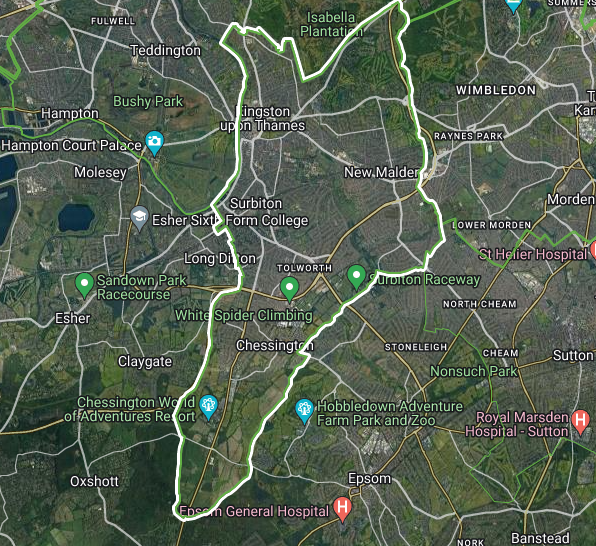
It is time for a slight deviation into local government history. The borough is very long and narrow, a 'panhandle' which protrudes from the rest of Greater London. When new plans to expand London's administrative boundaries were being discussed in the early 1960s, it was originally proposed that there would be 52 London boroughs, including Kingston and Epsom which were administratively part of Surrey. The residents of these suburbs, particularly in Epsom, refused to join the expanding capital, pressuring the Government to remove them from the final plan, leaving Kingston sticking out into the surrounding administrative districts of Surrey today.

Our next destination was in the middle of this curious 'panhandle', in Tolworth.


The Royal Borough of Kingston, the long 'panhandle' of Greater London


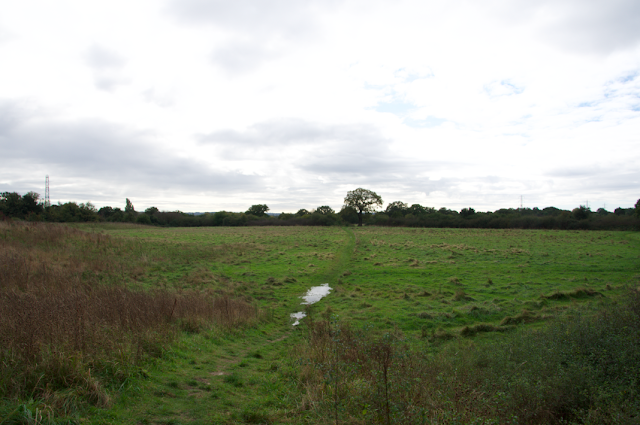
We parked in a ditch beside the roaring A240 motorway. In front of us were several nondescript fields, with access restricted by a large gate, which Elliot unlocked. It was unimaginable to think these fields had once been home to a Medieval moated manor.


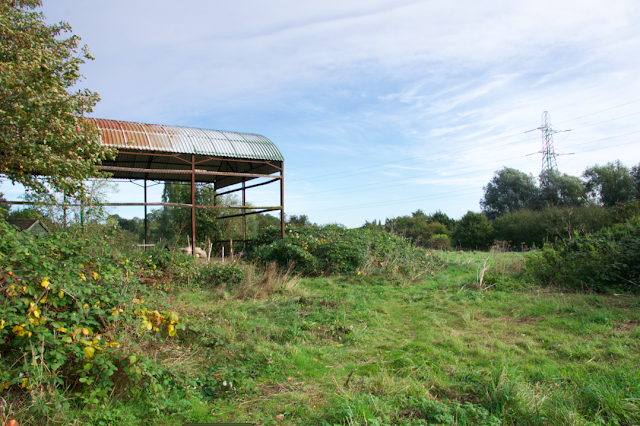
The fields were boggy and saturated by the rainfall from the past week, with Yellow Meadow Anthills spread out among the overgrown grass. With much difficulty, we trudged through the fields to a large cattle shed. Patches of scrubland bordered the shed, with tangled vegetation reaching out towards the poles supporting its arched corrugated iron roof. Just below one corner of the roof sat a Kestrel nestbox, though none had nested yet. In fact, Kestrels were not the only animal absent from the cowshed: so were the cows! Elliot hoped that cattle would arrive in the next few months, with their grazing improving biodiversity on the fields. Their hooves would turn the soil, spreading nutrients, and they would eat more numerous plant species to allow other plants to grow, increasing plant diversity. The idea of cows grazing in Tolworth had triggered a wave of excitement and enthusiasm among local residents, and over a hundred of them had signed up to visit the site and monitor the cattle's progress for most of the year. Cattle were connecting communities with urban nature; something I found truly remarkable.


The fields and cowshed near the A240, Tolworth


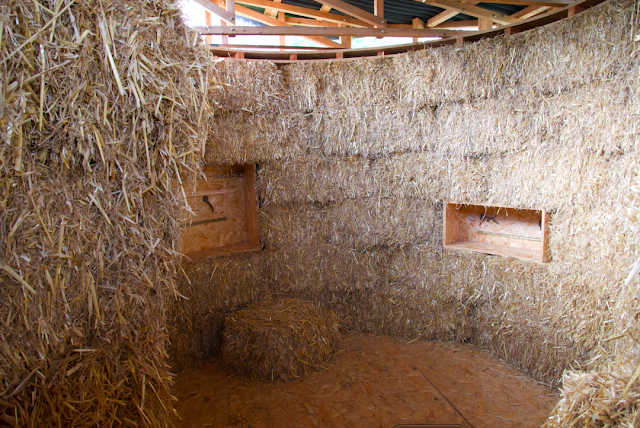
Once again, we walked with great effort through the boggy fields, from the cattle shed to a small bird hide at the opposite end of the reserve not too far away. On closer inspection, the hide's entrance had an exquisitely-carved wooden door knocker of a Kingfisher: a nod to the wildlife of the small reedbed which the hide sat next to, fed by the River Hogsmill itself. Gently opening the wooden door, we stepped inside into an interior rather unconventional for a hide. Hay comprised the inner walls and seating, giving a homely, warm and cosy feel. Wooden lids, with delicate handles carved in the shapes of different leaves, could be lifted from between the hay walls to reveal small circular windows looking out onto the reedbed. We fantasised about what birds could potentially be heard during summer. Perhaps an elusive Cetti's Warbler belting from a bulrush its piercing song, or maybe a Water Rail rustling in the reeds. But in October, the birds heralded the coming of autumn. The Moorhen, with its bubbly purr; the Song Thrush, its energetic whistles louder than the distant traffic; and the humble Blue Tit, with its sweet 'chu-chu-chu' trill.


I suppose the hide was like the manor house which once stood in its place. Not to watch over peasants from or defend from enemies, but from which one could enjoy the countryside in seclusion, tucked away from the hubbub of everyday life. One could feel that this was their little slice of paradise in the edgelands of South West London, surrounded by an array of pleasant bird calls and songs. And soon, the mooing of cows.


The interior of the hide


Leaving the fields and crossing the busy road, we reached a wooden bridge over a tangled riverbank: the Hogsmill. Concealed by masses of bright green overgrowth, the rare chalk stream let its presence be known with a timid babble.


The bridge led into Tolworth Court Farm Fields, a protected Local Nature Reserve open to the public. The first field was scattered with tufts of grass and nothing much else. Distant poplars towered above the field like sentries, standing guard at its boundary while looming over us.


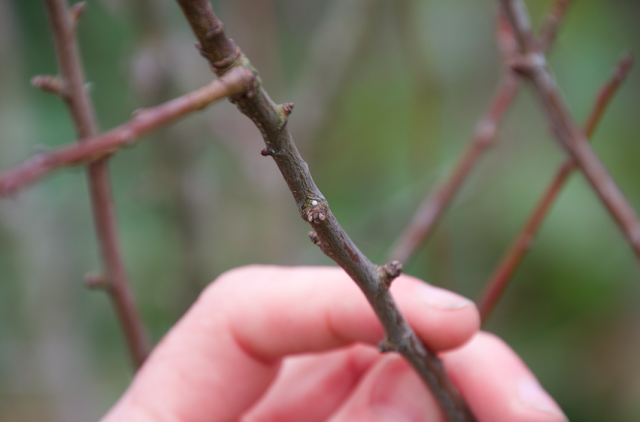
Other than the faint bubbly whirring of a Skylark, and brief sight of a Long-tailed Tit, this time of year was a quiet one for the birds of this reserve. Despite the lack of avian visitors, Elliot had remembered discovering something astonishing on his last visit, as we walked towards the vegetated field margins. He carefully examined each and every plant and exclaimed with delight when he had found it under masses of drenched branches: a single butterfly egg. A Brown Hairstreak butterfly egg, to be precise. This species is quite uncommon in London; even so, I had been lucky enough to catch a glimpse of one at Ruislip Gardens two years before, very close to my Eastcote home. The egg was a small white dot, about half a millimetre in diameter. However, zooming in on the egg using the macro setting on my camera revealed its wonderful detail. It resembled a sea creature of some kind, with symmetrical indentations dotted on its surface. A glimmer of life in this otherwise sombre autumnal meadow.


The Brown Hairstreak egg (the white dot in the centre of the twig). I did not manage to take any close-up photos of it!


We headed through a series of fields, all of which were very similar in appearance. Each had acres of tufts of grass, but were surrounded by a magnificent assortment of veteran trees, bushes and hedgerows, their wet foliage draped around them like verdant green robes. Weaving through sodden grass and climbing over a small hill, we chatted about our recent experiences in nature, what birds we had seen in our gardens, the local wildlife campaigns we had been involved in, and the increasing excitement around possible species reintroduction schemes in London. Elliot intended that the following year, he and other local conservationists from a charity he had helped set up, Citizen Zoo, would release Water Voles back into the Hogsmill. Many stretches of the river are too overgrown and in need of management, and Elliot believed Water Voles could rescue the Hogsmill's environment from biodiversity decline.


Much like the introduction of cows on the other side of the motorway, the thought of bringing back these iconic mammals to a rare, urban, chalk stream riverbank ecosystem had elated many residents. The voles' role in bringing back biodiversity to this ecosystem did not sound too dissimilar to that of the cows in the fields; their networks of burrows in the riverbanks would move nutrients around in the soil to increase plant growth, and their feeding on thick grass stems would control the growth of certain plant species and encourage the growth of others. The voles would provide the river with a much-needed cure, by engineering a small part of Kingston's vast urban jungle.


One of the Tolworth Court Farm fields with hedgerows


Elliot and I made our way along a short section of the A240 back to the car after walking out of the reserve. We drove towards our final destination in the leafy streets of Tolworth and Berrylands, not before meandering along Tolworth's criss-crossing main roads. Elliot mentioned that during the pandemic, murals of the borough's wildlife had been painted in the underpasses below by a local group, the Community Brain. The underpasses are situated in an area where residents have a lack of access to green space, so these murals would have allowed them to become familiar with their local wildlife in a way, even if it did not involve witnessing a Roe Deer prancing through long grass or hearing the 'kee, kee' of a Kestrel above.


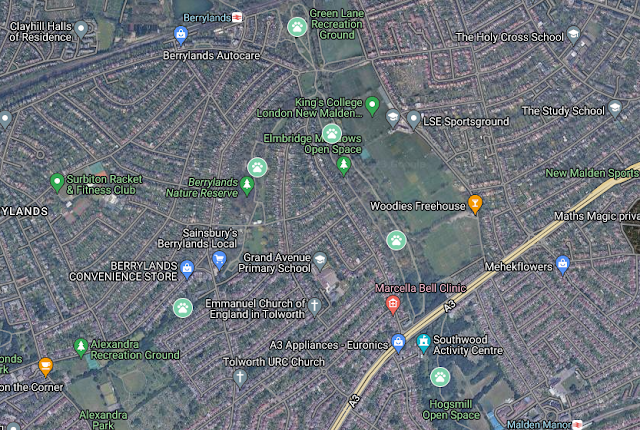
The streets of Berrylands were much quieter and mostly residential. A disproportionate number of green spaces in this sleepy suburb and its neighbouring areas are designated as Local Nature Reserves (LNRs), sites which are protected by law for their local ecological value. In fact it is this large number of LNRs that drew my attention to Kingston's natural environment in the first place, forming somewhat of a chevron shape when viewed from above.


Local Nature Reserves in Berrylands and the surrounding areas (from left to right): Edith Gardens, Raeburn Open Space (Berrylands Nature Reserve), Rose Walk, Elmbridge Open Space, Hogsmill River Park and Southwood Open Space


Between Rose Walk and Elmbridge Open Space was the peculiar sight of only two parking spaces crammed between a roundabout, a field and a cycle path. Given that there were at least twenty people ahead of us in the latter open space, it was a miracle that one of these parking spaces was free. Elliot and I left the car and walked along a footpath to the bridge. Here the Hogsmill, albeit murkier and appearing to flow more slowly than in Tolworth, came into full view. It was very exciting to think that from spring the next year there would be Water Voles here, let alone the existing Kingfishers, Emperor Dragonflies, Stag Beetles and Hedgehogs already along this stretch of the chalk stream. It is these five species that Elliot calls the 'Big Five' of Kingston, which he uses to illustrate the fantastic wildlife of the borough when educating local schoolchildren about nature.


Trees and overhanging vegetation prevented much access to the Hogsmill by the riverbank opposite the bridge, but showed off their resplendent autumnal hues of gold, russet and brown. Their leaves tumbled down and cloaked the riverbank, squelching beneath our feet as we sat down to admire the river. Dappled sunlight peeked between the thin branches, casting warm pools of light around us, while a Robin sang a few metres above, both of which comforted me amidst a rather cold wind. The not too distant sound of a train whistled through the air, to me a gentle reminder of this unique valley's urban location.


What Elliot, Citizen Zoo and other conservationists in Kingston are achieving is extraordinary. By connecting the borough's residents with their local wildlife through an ambitious nature restoration and rewilding programme, it makes me more hopeful that more areas of London will follow in their stride to enhance our capital's biodiversity. Of course, the Hogsmill Valley like many other ecosystems in the capital faces its challenges and issues, but the resolve and dedication of the locals is inspiring - a shining beacon of hope for this rare chalk stream and its Big Five.


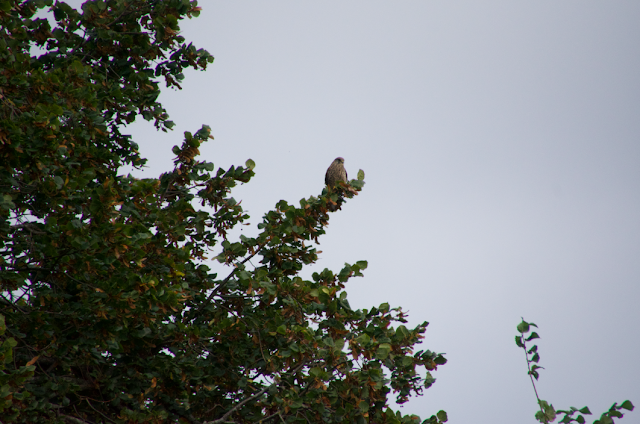
A Kestrel perched above the fields in Tolworth


Note: as this blog post was written based on a visit from two years ago, some changes have taken place. Shortly after my visit the cattle arrived in Tolworth, and in August 2022 Water Voles were reintroduced back into the Hogsmill!


Thursday, 7 July 2022

A Visit to Downing Street

6th June 2022


A couple of hours after a biology exam at school, I found myself stepping out of a black cab onto a clamorous Whitehall. The frustrated beeping of horns was audible in every direction, with traffic coming to a standstill as a Tube strike forced all commuters onto the roads. Between ornate Georgian facades and war memorials, crowds of protesters thronged the pavement outside the black gate to Downing Street. That evening, a confidence vote would be held in Boris Johnson's leadership. Tensions were running high among the protesters, who demanded his resignation, voicing their discontent through their megaphones. After narrowly squeezing between the protesters, and several elated tourists, I was granted entry to the heart of Government.


As someone who is fascinated by and studies politics, there are few words to describe the sight of the building. It was as if my mind had taken a journey through space-time for a few seconds and landed in an odd dream. I gazed with amazement at the meticulous, rather formidable-looking black bricks which enclosed the daily hustle and bustle of the Cabinet and the Civil Service. The sight of the black door - a door which represents countless years of Britain's politics, past and present -  made me question if this was reality. And the media were huddled a few metres away, anxious and desperate to catch a glimpse of any minister or advisor who might be able to comment on that evening's vote. Being on the periphery of Government was overwhelming to say the least.


The door's glossy surface was dappled with lighting from the camera crews, and from an old light in front of the door, supported by an arch. On either side of the door were bunting, in red, white and blue. A lunch in honour of the Platinum Jubilee was being held by the Department for Digital, Culture, Media and Sport (DCMS), to celebrate the work of volunteers and community leaders across the country. 


I had been invited for leading the 70 Nestboxes for 70 Years project, which saw 106 garden nestboxes and 20 Swift nestboxes being donated to schools across London. The project's aim was to encourage young people to notice and appreciate nesting birds in their school grounds, introducing them to urban nature in a simple way. It was carried out in celebration of the Queen's 70th year on the throne, which I thought would be a great vehicle to engage more London schools with environmental education. The response was unexpected, with not 70, but 106 schools signing up; this would have not been possible without the support of the Cameron Bespolka Trust, CJ Wildlife and Swift Conservation. 

The 107th garden nestbox would be placed in the Downing Street Garden.


The Jubilee lunch had coincided with the visit of Team England and the Commonwealth torch, to celebrate the Birmingham 2022 Commonwealth Games. While queuing to enter the building, I was not greeted by the Prime Minister or any civil servant, but a giant multicoloured cow - Perry, the mascot for the Games. He danced enthusiastically at the sight of my tie, which had a pattern of flying Kingfishers on it. He took a particular liking to it.


Soon after being received by Perry, it was my turn to enter Number 10. With mixed feelings of caution and wonderment, I reached for the intricate door knocker above the golden 'FIRST LORD OF THE TREASURY' postbox. I knocked on the door twice, and the footman answered and welcomed me to 10 Downing Street.


The door opened onto the splendid entrance hall. In front lay a short red carpet, flanked on either side by checkered flooring. There, another staff member informed me that phones were not allowed, so I placed mine in a small wooden cubbyhole by the door. I was led out of the hall through two modest double doors, to the left of which hung an imposing portrait of Sir Robert Walpole, the first Prime Minister of Great Britain. I wonder how many successors he had witnessed enter and exit by the black door over the years. 


The next room was a little more spacious, with a fireplace beneath a marble-coloured mantlepiece on the right. I left my coat and bags there, except the one containing the nestbox for the Garden. The next set of double doors led into a hallway, with busts, and lamps which cast small pools of light onto the floor. Yet another member of staff allowed me to proceed up the stairs to the right of the hallway: the famous staircase, which has been replicated in numerous films.


Tall lamps, which resembled miniature streetlights, marked the beginning of each flight of stairs. The bannisters were a radiant gold, but the walls were, frankly, quite an ugly, garish yellow; thankfully, much of it was hidden by portraits of past Prime Ministers. Black and white portraits of every previous Head of Government, from Pitt the Younger to Churchill, from Thatcher to May, lined the walls up until the end of the third flight of stairs.


It was here where I met DCMS civil servants Jake and Lara, with whom I had been corresponding via email over the past two years. We remarked how wonderful it was to finally meet in person, and I handed them the bag which contained the nestbox. It was whisked away by other civil servants into another corner of the Downing Street maze.


Jake and Lara had been coordinating the Prime Minister's Points of Light programme, where the Prime Minister recognises someone every weekday for volunteering on a local, regional or national scale. I had been part of the programme for two years, and this would be the first time I would have the chance to meet fellow Points of Light. In fact, the vast majority of guests at the lunch were Points of Light, ranging from scouts to war veterans.


From the staircase, the civil servants led me through a series of elaborate dining rooms. Each room was packed. People were huddled around seven to eight tables, each draped in Union flag tablecloths and laden with flags and mugs. Magnificent portraits of historical figures and monarchs hung from the walls: Elizabeth I, William IV, Raleigh, Shakespeare and two of Wellington, to name but a few. The wallpaper was a fiery orange-red. Each room had a subtle glow, provided by small lamps on exquisitely-carved wooden tables. The ceiling was embellished with beautiful chandeliers and touches of gold leaf, a contrast to the peeling paint around the windows looking out onto the Garden. 


The Garden appeared rather manicured, with small trimmed hedges and brightly-coloured flowers, interspersed with tables and chairs. Despite the visible lack of areas for wildlife, I did manage to hear the songs of a Robin and a Goldfinch, piercing above both the traffic outside and the excited chatter within the building.


Eventually, Jake and Lara managed to find an empty table, in a smaller room. This room had various modern art pieces, and another marble-coloured mantlepiece on which fragments of moon rock collected during one of the Apollo missions were displayed. I sat down at the table with two other Points of Light. Hassan Al Khawam, a Syrian refugee living in Northern Ireland, helped to set up the charity NI Hyatt. The charity supports refugees in Northern Ireland, especially with improving mental health, promoting integration, and providing representation in community decision-making. Jessie Davies, a campaigner who has used TikTok to raise awareness about her speech impediment, makes short videos on how it affects her in everyday life. Over a short period of time, her account has gained three million followers. 


Though the areas on which we campaign are very different, we did find many commonalities on our experiences of campaigning; these included gaining  meeting like-minded people through social media and working with different levels of Government, and the successes and challenges that come with it. We were also given the exciting opportunity to speak to one of DCMS's ministers, Sports Minister Nigel Huddleston, about our various campaigns and how the Government can support them. At this point Perry reappeared, dancing once again at the sight of my tie.


Later in the afternoon, Hassan, Jessie and I chatted over delicious afternoon tea; the scones were outstanding. Afterwards, I had some fabulous conversations with the civil servants on past Prime Ministers, general elections and other aspects of politics, while we walked around each part of the building and examined them in more detail. In a guarded hallway, I had the great honour of briefly meeting Larry the Cat. The portly tabby blocked the hallway, happily licking his paws, stretching and meowing with delight when his collar bell jingled. The security guards either side of him stood motionless like statues, clearly not entertained by the Chief Mouser. Neither was Perry, who had been leaping behind me through every room and hallway.


After three unforgettable hours, it was time to leave the heart of Government. I walked out of the black door and stopped to gaze at the Georgian terraces once more. The media were still waiting outside for a Government response to that evening's vote, now well underway. Back in reality, the sound of frustrated drivers echoed throughout Whitehall once again. Rush hour had arrived, the streets inundated with commuters. Fortunately there was one Chiltern line train leaving from Marylebone and heading in the right direction, to Harrow on the Hill. It was packed to say the least.


Outside Downing Street with the nestbox for the Downing Street Garden


-------------------------------------------------------------------------------------


NOTE: shortly after writing this, I unexpectedly received a photo from Downing Street in the post. It is of the nestbox, which the civil servants have put up in the Garden. I have informed them that it must be well out of reach of Larry's paws. Fingers crossed, the box will have its first residents next year!


The nestbox in the Garden


Saturday, 18 December 2021

A visit to Crossness, Bexley

 9th July 2021

Setting off from London Bridge, the Thameslink train rushed through the leafy suburbs of South East London. The high rises of Lewisham town centre quickly transformed into the quaint Victorian streets of Plumstead, which in turn became the 1930s-built houses of Falconwood and Welling. This was the first time I was visiting the borough of Bexley, drawn by one of its ecological secrets: Crossness Local Nature Reserve. Disembarking at Bexleyheath station, I met Ralph Todd, a local naturalist and conservationist, whom for the past few decades had led the RSPB Bexley Group with his wife Brenda. His wealth of knowledge - both about Bexley's environment and the natural world as a whole - was astounding. There was no better person to be exploring the mosaic of Crossness with. 


Driving from the station towards the Thames gave us the opportunity to view the borough's changing landscape. Beyond the houses of Bexley was the boundary with Greenwich, where the urban residential area had petered out, becoming the sprawling canopy of Bostall Woods. The Woods are an SSSI and a former haunt of highwaymen. Beyond the woods, the road eventually took us up over a flyover, giving us a sweeping view of all of Bexley. To the east was the 1960s-built Thamesmead Estate, where Ralph often conducted wildlife surveys, at an area of green space called the Thamesmead Ecological Study Area.


In front of the Estate lay the gargantuan Southmere Lake, and to the west, acres of sprawling parkland. As the flyover descended adjacent to Southmere Park, we entered the borough's forested motorways - endless, pleasant corridors of trees that seemed to stretch for miles in every direction. One of these corridors led us to a final defining feature of Bexley's beautifully discordant landscape: Crossness.


To our right, distribution centres bustled with the traffic of vans and lorries. And on the left, the fenced-off sewage treatment works, which concealed the subterranean Crossness Pumping Station (built to combat the Great Stink of 1858). Rows of reeds lined the roads, bursting out from behind the boundary fences. Towering above the reeds, sitting in between this industrial world and the marshland beyond it, stood two gigantic incinerators, appearing to guard their surroundings like sentinels. This was a wild combination of grey and green which I had never seen before in the capital. It was absolutely stunning.


Ralph unlocked the gate to the reserve beyond. Hedgerows lined the road to the nature reserve's footpath, while acres of surrounding grass and reedbeds swayed daintily in the light breeze. We disembarked from the car, and marvelled at this patchwork of habitats. A lone Sedge Warbler belted its fluid and babbly tune atop some teazels: Ralph remarked it had been singing frequently at this spot for the past few days.


Reedbeds at Crossness

These habitats have ancient origins, being in their present state as grazing marshes for at least 800 years. However, it is only because of the work of the Friends of Crossness volunteer group that it continues to be a thriving haven for wildlife. One of the group's leaders is Thames Water site manager Karen Sutton, whom we met as we arrived.


Karen introduced me to the work of the volunteers, who help to raise awareness of the site's biodiversity, record its wildlife, and look after its diverse range of habitats. The group's membership had seen a significant increase during the pandemic, and it was encouraging to learn that more people had developed a passion for their local green space.


After meeting Karen, Ralph and I walked to the beginning of the reserve footpath, bordered by inquisitive horses which had paused briefly from grazing in their pastures as they noticed us. We walked past channels where scores of common blue damselflies danced on the water's surface, while House Sparrows chirped and flitted above the abundant bindweed. Although some may find its flowers attractive, and they benefit bees and moths, Ralph warned that bindweed would be extremely difficult to remove from gardens if introduced.


Opposite the stream and the bindweed was a tall fence, separating Crossness Water Treatment Works from the reserve. Sections of the fence had been hidden by the growth of hedgerows planted by the volunteers: an astonishing sight of green coexisting with grey.


Linnet
 

Development on the ancient grazing marsh was not a novel occurrence. The first major change to the habitat took place in the late 19th Century, with the expansion of the Royal Arsenal munitions factory on Plumstead Marshes. Surprisingly, the marshes' birds were recorded quite often, by the munitions inspector Richard Ruegg. These included Red Kite, Bewick's Swan in winter, and even Little Bittern. Unfortunately Plumstead Marshes no longer exist today, gradually eaten away by developments such as Thamesmead. Today the surviving Erith Marshes and Crossness, though threatened, still have a plethora of bird species.


The path soon rose from the hedges, fences and channels, into an expanse of gorgeous scrubland. Linnets chatted noisily in all directions, darting furiously in the muggy air, with the sound of jangling keys emanating from the scattered bushes. Ralph suspected the population had had their second broods, which had recently fledged.


By this time of the morning, the sun had peeked from behind the newer of the two incinerators, illuminating the scrubland in a haze of bright gold. The scrubland itself was still fairly quiet, apart from the Linnets and the odd 'peewit' of a Lapwing, so we ambled up along a ramp to see what birds Old Father Thames could offer.


Lush reedbeds clung on to the mudflats as the river lapped against the banks, from which intermittent explosions of Reed and Cetti's Warbler song emerged. Clustered around the reeds' delicate stems, Oystercatchers preened their feathers, and a Common Sandpiper trotted in circles, in clumsy desperation, searching for something to eat in the mud. Great Crested Grebes, an uncommon sight in a river, seemed to prefer the edges of the reeds. Their spherical bodies bobbed up and down in the waves until they disappeared beneath the surface.


A rushing sound filled our ears. The sewage outflow from the treatment works spilled out noisily into the river, met by the raucous chattering of seventy-five Black-headed Gulls. From this I remembered learning from social media about the rare gulls that the reserve has hosted in the past, and asked Ralph if we might be lucky enough to see a Bonaparte's Gull that day. Instead, he challenged me to identify one among the indecipherable flock of gulls in the water, at which I failed miserably.


The sewage outflow was enveloped in a large shadow, cast by the older of the two incinerators. The looming sentinel's facade seemed to have grown weary, with dust gathering on its intricate and undulating spine. It hummed with determination, in competition with a Water Rail which croaked in the undergrowth beneath it. 


Industry was present on both sides of the Thames. The famous Ford plant dominated the view of Barking & Dagenham, its blue logo like an eye staring back quite ominously at the incinerators. The factory was the centre of a rugged landscape, a remarkable clutter of wind turbines, cars, trailers and chimneys. the only natural feature was the Beam River, a sliver of green squeezed between the landscape's corrugated crevasses.


The Thames between Barking & Dagenham and Bexley


Retracing our steps from the Thames, we soon came face to face with the newer incinerator. Atop its spine, comparatively shinier than that of its neighbour, sat two Peregrine falcons. The species had become increasingly common in the capital, favouring taller buildings to nest in, which imitated the cliffs where they were once more commonly found. One falcon was slightly larger than the other, a female, gazing authoritatively over Erith Marshes; while the male looked perplexed, frantically turning his head in every direction. Peregrines were yet to breed in the area, though there had been a breeding pair in nearby Abbey Wood.


Before lunch, we stopped at a recently-built viewing screen overlooking the grassland and marshland in front of the newer incinerator, which we had seen upon our arrival. Ralph informed me the area of marshland was known as the West Paddock. Two years before, Lapwings had successfully bred on these fields for the first time: a glimmer of hope here for this red-listed species, sheltering from the ever-encroaching shadow of human interference.


We retreated from the afternoon heat to the protected area of the reserve, to eat our sandwiches. Secluded by foliage and a charming weather vane, the hexagonal Friends of Crossness bird hide offered 360-degree views of reedbeds. Ralph explained some of this habitat had occurred naturally, but through the efforts of the volunteers, an extra 72,000 reeds had been added, creating a valuable habitat for waterbirds and warblers. Among the topics we discussed were our planned birding trips abroad, many of which had been cancelled due to the pandemic; and how to encourage more young people in Bexley to enjoy the natural world.


After lunch, we headed into the reedbeds, listening out for Willow Warblers, Blackcaps and Chiffchaffs concealed in the overhanging trees. The golden reeds evoked memories of Titchwell Marsh and Lakenheath Fen, and the sanctuary they provided for Bearded Tits, Bitterns and other charismatic species. It would not be impossible to imagine them visiting Crossness, if they had not already in the past.


Venturing out of the reedbeds, we reached a viewpoint overlooking the marshes, and the hubbub of development and distribution centres around it. It offered a moment of reflection for both of us, on the future of Crossness. Its wildlife was still at risk from the onslaught of the built environment.


Ralph explained that two data centres and yet another incinerator will replace replace the marshes and their red-listed species next year. He and other local conservationists had campaigned against this, but it was heartbreaking and frankly unimaginable to think that this habitat, with its ancient origins and incredible array of wildlife, would be lost forever in a matter of months' time. From my own experiences of campaigning, to save Warren Farm in Ealing from future development, it is an important part of uniting communities and raising awareness of the threats faced by nature reserves like this one.


Crossness is indeed an extraordinary hidden ecological jewel in Bexley's crown, with its fragile habitats and species diminishing over the centuries. But what remains is stunning, and its future will be determined by greater awareness and cooperation between everyone to protect it. Only then will future generations be able to hear the 'peewit' of a Lapwing in urban Bexley.


The fields of Crossness, with Lesnes Abbey Wood behind it


Thursday, 19 August 2021

A Green Roof in Greenwich

4th July 2021

Upon arriving at North Greenwich station, I walked to the bus stop, where I was greeted by the gigantic tree-lined car parks surrounding the O2. In fact, there were not many trees at all - in their place stood towering office blocks, some of which looked quite futuristic and otherworldly. This concrete metropolis seemed to stretch for miles around; however, I had forgotten that wildlife thrived here in a most unusual way.

The bus passed through much of this emerging urban jungle: brownfield sites, new villages and flats enveloped the landscape. That is, until I reached an IKEA. Beneath this large blue shipping container I met Dusty Gedge, a real champion of green infrastructure who had promoted the use of green roofs in cities over the past few decades. Last year he had introduced me to the stunning parks and rivers of urban Lewisham, but now, we were visiting a habitat created entirely by people.

We climbed a staircase to a large grey door. Like a portal to another dimension, it opened onto an endless array of gardens. The grey, polished IKEA flooring had transformed into a lush carpet of sedum, and mesmerising views of the capital, both urban and rural, stretched for as far as the eye could see in every direction. The charming call of Linnets could be heard above the noise of traffic below, and Pied Wagtails darted their heads from side to side in utter confusion, before flying back into the urban sprawl.

The IKEA Greenwich green roof (credit: Aryan Kaul)


Scattered among the sedum grew the beautiful Viper's Bugloss. These gorgeous plants were filled with Bumblebees, nestled in between their glowing blue and purple hues. In fact, the Viper's Bugloss Bee had been discovered recently in Greenwich, a new species which Dusty hoped would visit the roof.

Adjacent to the sedum was a kitchen garden, where onions and delicious strawberries grew. Artificial grass and deck chairs - far different from the surrounding vegetation - lay at the heart of the roof: perhaps a place for IKEA staff to rest and take in the views. However, the most striking feature of this novel environment was its variety of wildflowers. Facing the gleaming skyscrapers of Canary Wharf grew scattered numbers of Chicory, Purple Toadflax, Oxeye Daisy and Common Vetch, clinging onto the soil in the wind. This assortment of hardy flowers had been collected locally by Dusty, from around Southeast London.

Dusty described green roofs as 'tough places'. There are several challenges involved in creating and maintaining green roofs - a great deal of resilience and patience is required. However, they have certainly gained popularity. Over the years, an expectation of green roofs by local authorities in London had been formed, and Greenwich now had the third largest area of green roofs in the capital. In fact, forty percent of the green space in the surrounding new developments consisted of green roofs. 

The microclimate and location of green roofs attract a whole range of biodiversity. Dusty had suspected that the Greenwich roof was home to a nesting pair of Linnets, the first instance in Europe, let alone in the UK. Crucially, green roofs across the capital had aimed to boost the capital's population of Black Redstarts, which favour industrial and urban environments. None had visited the Greenwich roof yet, though they had become a frequent sight in Westminster and Canary Wharf.

The IKEA Greenwich green roof, facing Canary Wharf and the O2 (credit: Aryan Kaul)

Invertebrates had become rife too. A Migrant Hawker flitted past us, and a few Craneflies scuttled along the gravel as we admired the wildflowers. The Purple Toadflax was a favourite of moths, namely the Toadflax Brocade Moth; and of course, there were the bees, gently tending to the myriad of flowers, with bulbous bags of pollen grasping their legs. 

It is remarkable to think how quickly this new ecosystem had been developed; starting with a few seeds collected locally, plenty of insects arrived, and birds took refuge in the bushes that soon sprouted. The fact that green infrastructure is on the rise certainly makes me optimistic about the future of wildlife in Inner London. The IKEA Greenwich green roof was created by people through sheer determination and resilience - it is testimony to what we can achieve in accommodating wildlife within our inner cities.


Tuesday, 29 June 2021

Evening walk around Warren Farm

10th June 2021

On a mild June evening my mum, brother and I travelled to Norwood Green in Ealing; we were visiting Warren Farm! For the last three months I had been confined to a desk at home and at school, preparing for and sitting exams respectively. The end of this challenging period had led to the beginning of a much more eventful one, giving me more opportunities to spend time in urban green spaces.


Upon arriving in Hanwell, we walked briskly through its seemingly-rural streets, with rows of Edwardian houses and a village green. After passing the confluence of the Grand Union Canal with the River Brent, we arrived just in time to meet other campaigners from Warren Farm Nature Reserve. We met Katie Boyles again, a conservationist who has widely publicised the Warren Farm Nature Reserve campaign, which I have been part of for the past two years. I had only been communicating with campaigners like Katie for the last year through phone calls and emails, so to meet some of them in person gave us a chance to share our enthusiasm for the natural world, and our excitement for the future of Warren Farm.


The leading campaigners at Warren Farm Nature Reserve are a team of conservationists, botanists, ecologists and entomologists who would like to see Warren Farm and the surrounding habitats designated as a Local Nature Reserve; several of them were at the walk. We were soon joined by a much larger group, the Hanwell Village Green Residents' Association. It was very uplifting to see so many people here, who shared a common vision for the meadow. 


Starting at Trumper's Field, we headed beyond the railway line and past the entrance gate. Here, ornithologist Phil Belman, leading the walk, informed us of the signs of an acid grassland habitat. Acid grassland is a very rare habitat in both London and Middlesex, and can be identified by the dominance of red-coloured grasses. Indeed, as the sun set, red and orange pockets were illuminated across the landcsape, transforming the meadow into a rare quilt of colour. We listened in awe at the endless bubbly, scratchy song of the Skylark from deep beneath the grass, accompanied by the occasional Blackbird or Song Thrush: a chorus that would disappear forever if this site were to be lost.


Phil led us towards the Imperial College field, which is grazed by a few silent horses. By now the sky had become a brilliant orange, settling above a strange assortment of buildings in the distance, which included several tower blocks and the GSK headquarters. Here, Phil emphasised the importance of Warren Farm Nature Reserve's vision; not just to make Warren Farm a Local Nature Reserve, but to connect it to the surrounding private land, to form a wildlife corridor between different habitats. Excited chatter continued to rise at this idea, as we slowly walked towards the brownfield site.


Warren Farm Sports Centre today lies deserted and derelict. Its changing rooms are now merely large blocks of concrete, daubed in graffiti. Yet even here, from between cracks in the ground, a vast array of plants have grown, allowing nature to reclaim the site. The former sports centre, despite being an eyesore to some, has been visited by Kestrels, a Black Redstart and even a Wryneck, with the latter starting a small twitch in September 2020. We can only guess what rare and unusual species will visit this unlikely habitat in the future.


Walking along the meadow's southernmost path and away from the brownfield site, a myriad of familiar screeches from above became audible. Dozens of Swifts danced like aerial acrobats in the air, gracefully moving their scimitar-like wings to catch the meadow's multitude of insects. Meanwhile, an isolated group of trees and shrubs concealing the busy Windmill Lane from the meadow, were rather silent, except for the occasional 'ticking' sound of a Blackbird. This area was a Site of Importance for Nature Conservation, and once had a fence around it - this was removed a few years ago, allowing wildlife to travel between the meadow and neighbouring Osterley Park. Adjacent to this wildlife site was another fence, separating Warren Farm from a field owned by the Earl of Jersey, and beyond the field, an ancient woodland. Warren Farm Nature Reserve hope that the field can become part of the Local Nature Reserve too, thereby creating a larger wildlife corridor to sustain Warren Farm's populations of rare species.


As we completed one full circle of the meadow, half of the group stopped abruptly near trees bordering the River Brent. Phil had spotted something in the trees, only viewable with a night vision monocular. As I looked through the monocular, there was not any obvious movement between the tangled branches: until, a pair of radiant white orbs stared back at me, possibly bewildered at the sight of visitors. A Little Owl chick!


This evening walk around Warren Farm not only gave me the opportunity to meet fellow campaigners and residents and share our ideas and enthusiasm, but also encouraged me to feel more optimistic about the future of its unique biodiversity. I would highly encourage visiting this stunning urban meadow, and I hope that one day, its incredible wildlife can be protected for generations to come.


Warren Farm, May 2020

Sunset over Warren Farm (photo: Gayatri Kaul)

Friday, 28 May 2021

Summer Holiday 2020

18th July 2020

The start of the summer holiday definitely helped me to forget about the stress of lockdown, which came from sitting in one room all day doing schoolwork! I visited what is one of my favourite places in the whole of London, Barnsbury, in Islington (I wrote about its history in a previous post, here). I was once again greeted by the old industrial buildings and the late Georgian architecture, as well as the Coots, resilient and resourceful birds. Even when exiting the towpath and entering the immense Barnsbury Estate, there was wildlife, in the form of a Blackbird hopping frantically around a berry bush. When I returned to the Canal through a circular walk, Canada Geese swam gracefully towards the Islington Tunnel, and a huge Emperor Dragonfly buzzed enthusiastically around the wilder part of the Canal, next to the London Wildlife Trust's Camley Street Natural Park; this urban nature reserve is currently closed, though I hope to visit in the future. A short, but memorable afternoon.


Cube-shaped trees in Granary Square

A Coot sitting on its nest

Coot

Blackbird

Eyed Hawkmoth Caterpillar

A feeding station overlooking the Canal

A family of Canada Geese


22nd July 2020

I returned to the splendid Warren Farm, where it was brilliant to bump into Neil Smith, the local meteorologist. The meadow did not have many visitors, though unfortunately somebody walked into the long grass, causing at least six Skylarks to shoot up into the air in confusion. The acid grassland habitat was teeming with Linnets and Goldfinches; in the old oak tree, there were a dozen Mistle Thrushes; and the alarm calls of Little Owls could be heard along the canal. This reminded me of the paradise that Warren Farm is, and that its diverse range of species needed protecting.


Mistle Thrush in flight

Mallards

27th July 2020
Over the lockdown I had learned about an area of scrubland adjacent to Roxeth Recreation Ground in South Harrow, where I used to live. If I still did live there, this would have probably been my patch! Officially called Roxeth Park Natural Area, the scrubland habitat is home to a variety of migratory species such as Whitethroat and Chiffchaff, and a male Willow Warbler was recorded singing there in the spring. A lot of insects and resident birds like Greenfinches, Nuthatches and House Sparrows thrive here too, despite the site being near a busy railway line.

Black-headed Gull on Roxeth Recreation Ground

Red Kite soaring above

Roxeth Park Natural Area

31st July 2020
A very exciting morning! I would be taking part in podcast for the London Design Festival, about the bicentenary of the Regent's Canal, including its history and its wildlife. I was going to narrate the podcast and interview a designer over the course of the holidays, but today I was with Justine, Sarah and Deborah from There Project to create an audio guide for the stretch of the Canal between Angel and Haggerston. We started at the Islington Tunnel, and slowly walked along the towpath. It was superb to talk about how birds such as Coots and Peregrines have adapted to life on the Canal, and describe its industrial history.

At the end of the route, we went to Kingsland Basin, managed by the amazing Wildlife Gardeners of Haggerston. Thanks to their conservation efforts, the stretch of the Canal from Whitmore Road Bridge to the Basin now has a wealth of wetland species: Cormorants, Herons, nesting Mute Swans, Emperor Dragonflies, various species of fish and a population of Cockney Sparras all thrive here. This is definitely urban conservation at its finest!


The towpath at Haggerston

Field Grasshopper

A very wild area of scrubland beside the towpath

Coots have adapted exceptionally well to the Canal's environment

Kingsland Basin, Haggerston

Cockney Sparra (House Sparrow)

A Red-eared Terrapin!

Kingsland Basin, with the City behind it

3rd August 2020
During the past few months I had tried to visit local wildlife sites and nature reserves, including my patch, a lot more often. I had heard that there was a small number of Brown Hairstreaks at a green space called Ruislip Gardens, a collection of open spaces that is part of the larger Ickenham Marshes. It was fascinating to think that this species was very scarce in London, yet on my doorstep! Much of Ickenham Marshes, including Ruislip Gardens, used to be common land, and now a part of it is managed by the London Wildlife Trust. It is even mentioned in the poem Middlesex by former Poet Laureate Sir John Betjeman, with the first line being 'Gaily into Ruislip Gardens/the red electric train'.

When I arrived, there were tall hedgerows on either side, with House Sparrows and Blue Tits flitting about in them. These hedgerows led into a complex of woodland and scrubland, with several Gatekeepers, Brimstones, Small Tortoiseshells and Large Whites moving gently among the abundance of flowers. On one of these flowers sat the butterfly I was looking for. I forgot to take a photo in my excitement!

At the edge of this mosaic of habitats was the Yeading Brook, a river which flows through many of my local green spaces, and into the Thames as the River Crane. Beyond the river was a rather different landscape, RAF Northolt. Here, Blackcaps and Chiffchaffs sung away in the overhanging trees, and large dragonflies darted above the water. With the lack of visitors that afternoon, Magpies began to dominate the scrubland, both with their presence and their 'cackling'. I hope to visit Ruislip Gardens more often in the future: an excellent habitat for the borough's birds and butterflies.

The wild paths of Ruislip Gardens

Gatekeeper


12th and 22nd August 2020
The holidays had given me a lot more time to reconnect with my patch, Ruislip Woods, too. I met up with local young birder, Alex Liddle, who had found some amazing summer migrants that had arrived in an area of meadow and scrubland west of the Lido called Poor's Field. From the morning to the evening, the field was alive with the song of warblers, and it was here I began to appreciate how beautiful the plumage of these birds can be! One morning, Alex had found a Pied Flycatcher, a rather uncommon visitor to the Woods. Ten minutes later, the sighting had attracted several other local birders; while we were cautiously scanning the bushes for the bird to reappear, a male Redstart, displaying its striking orange-red chest, darted seemingly out of nowhere!

Other species that were sighted that month included Winchat, Spotted Flycatcher and Tree Pipit. I think that Ruislip Woods as a nature reserve and birding site is not widely known or celebrated for its wildlife as much as it should be, though with larger numbers of visitors throughout the pandemic, I am hopeful that more will discover its ability to surprise and impress.

The scrubland habitat of Poor's Field

Egyptian Goose at the Lido

Cormorant

Poor's Field, also known as Ruislip Common, is home to Chiffchaffs and Willow Warblers in summer

Speckled Wood

15th August 2020
After hearing on Twitter about a pair of Great Skuas (or Bonxies) flying above Spelthorne, I headed to Staines Reservoirs to attempt to see them. Unfortunately they had flown west towards Berkshire by that point, though it was great to return to the site after a number of months. It was also the first time in a while that I used my relatively new scope: this gave me decent views of Black Terns, a Little Ringed Plover, a Dunlin, and one of the site's star species, the Black-necked Grebe!

A distant Black-necked Grebe

18th August 2020
In the morning, my mum and I travelled to Uxbridge's Little Britain Lake, to meet conservationist John Randall. I first met John at a reception at the House of Lords in 2018, and ever since he has encouraged me to learn about the wildlife of Hillingdon and London as a whole. Recently, he introduced me to Middlesex Heritage, and with the organisation's president Russell Grant, we launched a competition to determine Middlesex's historic county bird.

John introduced us to the different areas of the Lake, and the species that live there. There were several Great Crested Grebes, Egyptian Geese, and other wildfowl species on the main lake. The path that circled that lake led onto a narrow trail, with dense foliage on either side and the sound of birdsong: these tranquil trails are a characteristic of the Colne Valley, which I am lucky to have right on my doorstep. This was the Hillingdon Trail, which extends across the breadth of the borough, from Harefield in the north to Cranford in the south.

We walked over the Grand Union Canal's Slough Arm, where Blackcaps and Chiffchaffs sang in the bushes. Beyond this was the River Colne, and a number of lakes. Here it was rather quiet, with a few Tufted Ducks and Canada Geese present. When we followed the path back to the main lake, we were surprised by at least five Cormorants and a large flock of Gadwall! Visiting Little Britain Lake, among other local sites, has definitely taught me to value and appreciate the vast range of habitats and species found in Hillingdon.

Little Britain Lake

Family of Coots

Great Crested Grebes

Gadwalls

21st August 2020
Local birder and conservationist Samuel Levy and I visited a wildlife corridor in Hillingdon and Ealing, collectively known as the Yeading Wildlife Sites. This beautiful area of woodland, scrubland and parkland is part of the wider Crane Valley, and was effectively my lockdown patch!

We entered Gutteridge Wood, which, along with Ten Acre Wood, make up the Yeading Woods Local Nature Reserve. The wood is semi-ancient, and has very impressive bluebell displays in spring. Kingfishers frequent the banks of the brook, though on this particular visit, the yaffling of Green Woodpeckers and the song of warblers filled the trees. Deeper into the woods, we heard Bullfinches, and now there was a repetitive shriek, similar to that of a Parakeet, though shorter and sharper. Samuel had identified these as Hobby fledgelings! Three of them were perched high up in a dead tree, looking towards the endless maze of fields and the bustling A40, presumably in search of a meal.

The winding Hillingdon Trail lead out of the wood, and into a vast complex of open spaces, the Yeading Meadows Local Nature Reserve. Parts of this reserve had cattle grazing and small bodies of water, home to Moorhens and Coots, were fed by the Yeading Brook. Autumn migration had begun, and strong easterly winds had brought Wheatears! As we walked into one patch of scrubland, we came across one of these autumnal migrants, a stunning Spotted Flycatcher, which was an excellent record for the area. Small Copper and Small Heath butterflies were also the highlights of this scrubland. Hedgerows, vital habitats for many nesting birds, could be seen in Yeading Meadows: a lot of the hedgerows in West Middlesex were planted during the Enclosure Act of 1804, so perhaps these ones were over two hundred years old!

We walked across a boardwalk and into Ten Acre Wood, another London Wildlife Trust nature reserve. This wood is at least one hundred years old, beginning life as a small plantation. The calls of Kingfishers were heard briefly along the riverbank. A large area of scrubland lay behind the wood, which provided a home for Whitethroats in summer, and Redwings and Fieldfares in winter. The wood itself was eerily quiet, with a few woodpeckers, Robins and Magpies hopping around in the ancient trees.

The last of these magnificent sites can be found past Hillingdon's border with Ealing. We crossed the Golden Bridge, built in 1984, and into Yeading Brook Meadows in Northolt. This site is particularly good for raptors, and this morning there were hunting Kestrels, and the call of juvenile Sparrowhawks begging for their parents to feed them could be heard in a distant tree. This is one of Ealing's last strongholds for Skylarks, which have become increasingly rare in the region. The bushes on the reserve's boundary were chattering with warbler, thrush and tit species, and Muntjac (or 'barking deer'), introduced into Bedfordshire by accident in the 19th Century, sometimes can be found in the open grassland habitat, though there were none on our visit. There were even Roesel's Bush Crickets in the long grass, a species which has become more common in recent years.

The beginning of autumn had brought many surprises to the Yeading Wildlife Sites, though they are spectacular all year round!


Hobby fledgelings!

Spotted Flycatcher, or 'Spot Fly'

Roesel's Bush Cricket


27th August 2020

Towards the end of the holidays, I once again found myself among the nineteenth-century leafy suburbs of Lewisham. I was going to meet Anna-Maria and Nick from the Buckthorne Cutting Nature Reserve, a quite railside wildlife corridor just a stone's throw away from the bustling Honor Oak Park. A remnant of the ancient Great North Wood, the reserve and its surroundings are rich in history; in fact the name of Brockley where it is situated, derives from 'Broca's wood clearing'. The early 19th Century brought industry to the area, then known as Brockley Green, through the construction of the Croydon Canal - this short-lived waterway closed in 1836 and is now the railway between New Cross and Honor Oak. A century later one of the first scout groups was formed, the Brockley 5th also known as the 'Dandy Fifth'. Over the next ninety years their scout hut and the surrounding park was used by hundreds of scouts, until its closure in 2004. Anna-Maria and Nick informed me they were campaigning to reopen it, to give more local children the opportunity to learn about nature.

We walked through a maze of tangled tree branches, and looking upwards into the canopy made me appreciate the age of this unique ecosystem. After walking down a long, winding path, we reached a large clearing. The ground was littered with small spherical stones - the volunteers here believed that these were sarsen stones. Overlooking the railway was a huge platform which Anna-Maria and Nick had built very recently; an outdoor classroom, encouraging children to immerse themselves in this stunning nature reserve. Beyond this clearing lay something very unusual, yet remarkable. In the middle of this sprawling complex of ancient woodland lay a reedbed. This seemed like the perfect habitat for species like Reed Bunting and Cetti's Warbler, which I was very excited by. Though there had not been much wildlife visiting it, Anna-Maria and Nick remained optimistic for the reedbed's future. 

Many do not imagine such stunning habitats being situated in Inner London, yet here was a magnificent ancient woodland filled with the yaffles of Green Woodpeckers and the song of Blackcaps. This hidden haven for biodiversity situated next to a busy railway is thriving through the local community, and I am looking forward to visiting again one day.


The dense vegetation of Buckthorne Cutting, part of the Great North Wood

One of the many sarsen stones at the nature reserve

A possible marker of a parish or historic county boundary

The outdoor classroom

Later that day, I travelled to the north of the borough to meet the inspirational Dusty Gedge at Brookmill Park. Dusty helped to bring green roofs and green infrastructure to London in the 1990s and 2000s, a new habitat which had led to Black Redstarts thriving in the capital. It was fabulous to talk about London history, urban wildlife, and the birds found in Lewisham and Greenwich - we followed the course of the Ravensbourne River, which was home to Kingfishers! The Ravensbourne was sandwiched between tall buildings and busy main roads, yet Little Egrets, Coots and Moorhens had adapted to live in this truly urban setting. As the river became Deptford Creek nearer to the Thames, Dusty was reminded of the Whitebait Supper. This was a meal attended by cabinet ministers before a State Opening of Parliament in the 19th Century, at the pubs of Deptford and Greenwich. Whitebait are young herring or sprat deep fried and seasoned, and were once commonly caught in the Thames and its tributaries; though this is less prevalent today.

After this insightful walk with Dusty, I very briefly visited Confluence Park in Lewisham town centre. This small and relatively new green space is the confluence (as the name suggests) of the Ravensbourne and the Quaggy, though unfortunately there were not any Kingfishers when I visited!

Mallards in the Ravensbourne

The Ravensbourne at Brookmill Park LNR

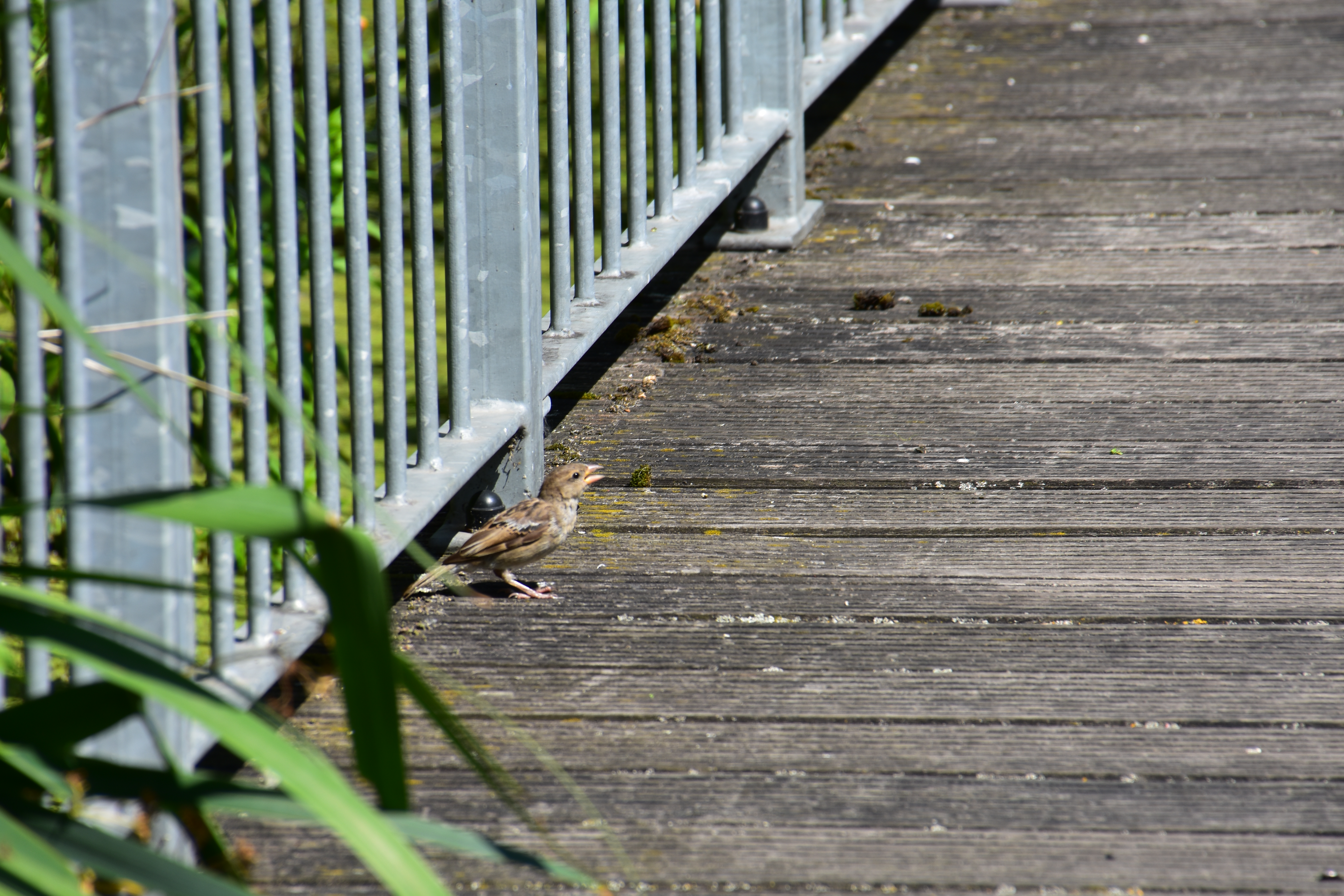
House Sparrow

The confluence of the Ravensbourne and Quaggy

28th August 2020
In the morning I met my mentor David Lindo, at his patch, Wormwood Scrubs in East Acton. It was fantastic to catch up after a few months, as well as to return to this impressive nature reserve. One of London's best birding sites, it is an important stop for migratory warblers. Autumn migration had begun, so the scrubland was alive with the scratchy songs of Whitethroats, Lesser Whitethroats and Blackcaps. I learned a lot from David about the history of the site, from being part of the Forest of Middlesex, to becoming a Prisoner of War camp in World War Two.

Hedgerows and scrubland

Cormorant

The playing fields, which have provided an unlikely resting point for some rare migratory birds over the years

A Kestrel flies overhead

Carrion Crow

31st August 2020
I met Samuel again, this time at his patch in the Totteridge Valley. I had previously visited around a year before, but with the knowledge that autumn migration was taking place, I was very excited! We headed from Totteridge Common through some large fields, and to Darland's Lake Nature Reserve. Samuel had seen some Teals in recent times, though the lake only had Coots and Moorhens on this particular morning.

Vast, sprawling farmland and fields were the dominant habitat of the Valley. In one of these fields, Samuel found a number of Rooks amongst Jackdaws and Carrion Crows. We walked up a hill and past cornfields, where we had seen a number of Whinchats the previous summer, though it was rather quiet today. Nevertheless, as usual, the sky gave us several raptor species - Red Kites, Buzzards, Sparrowhawks and Kestrels. The most memorable part of the day was visiting a little-known viewpoint, and being greeted by the London skyline! To witness a Hobby darting past the City of London was very remarkable, emphasising how important these farmland habitats are to the biodiversity of the capital's fringes.

The scrubland of the Totteridge Valley

Darland's Lake Nature Reserve

Rooks - an increasingly rare corvid in London

The cornfields

The Totteridge Valley, with Central London and Canary Wharf in the background

Buzzard


The summer holidays had given me the chance to learn and discover more of London's unique wildlife, and meet more of the people who protect it. Also, visiting your own patch more regularly can be very rewarding: you never know what you might find!